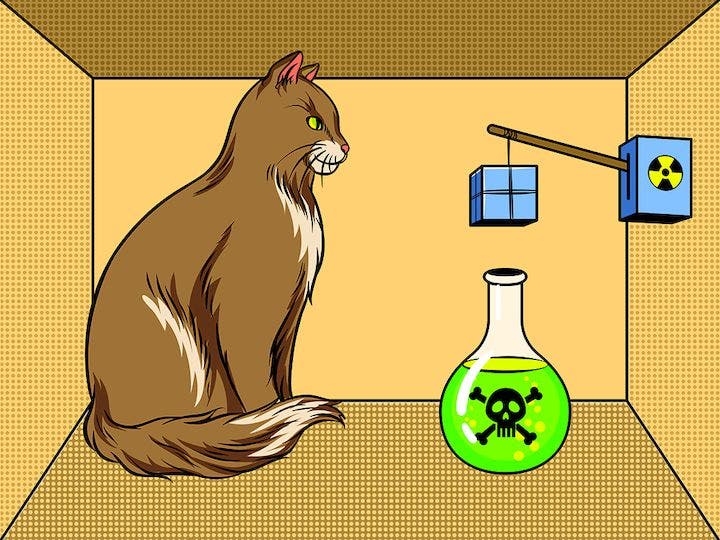
Quantum mechanics might seem a world away from the consultation room or the pharmacy counter, but the famous thought experiment of Schrödinger’s Cat offers a profound metaphor for the daily reality of clinical practice.
The story has always fascinated me. The physicist Erwin Schrödinger proposed a scenario where a cat is placed in a sealed steel box along with a flask of poison, a tiny amount of radioactive substance, and a Geiger counter. If a single atom decays, the counter detects it, shatters the flask, and the cat dies. If not, the cat lives.
According to quantum mechanics, until someone opens the box to check, the cat exists in a state of "superposition." It is simultaneously both alive and dead. The reality is only determined when the observer opens the box.
The Patient as the Box - allow me to propose this analogy, probably hypothesis:
Every time a patient presents with a symptom, we are essentially presented with a closed box.
Inside that box lies the diagnosis. Is this chest pain indigestion (the cat is alive) or a myocardial infarction (the cat is dead) - may be other differentials? Is this headache a tension headache or a subarachnoid haemorrhage? At the start of the consultation, the patient exists in a state of clinical superposition. The maladies are all possible at once.
Our job as clinicians is to determine the state of the cat without necessarily being able to tear the box open immediately. We rely on the tools we have, and the most powerful tool is the patient’s story.
The 80% Rule and the "Historian"
Research suggests that upwards of 80% of diagnoses are made on the patient history alone. Physical examination and diagnostic tests often contribute surprisingly little to the final diagnosis compared to listening to the patient.
However, this places immense weight on the quality of that history. How good is the history? At times patients are described as not being able to give a clear account of their symptoms. As some researchers argue, the patient is the source; the clinician is the historian chronicling the event.
If the history is vague, is it because the patient is confused, or because we failed to ask the right questions? Like Schrödinger's observer, our ability to determine reality depends entirely on how we look at the box. If our enquiry is flawed, the cat remains in superposition, and the diagnosis remains uncertain.
Opening the Box: The Reality Check
Ultimately, the "superposition" collapses and the reality is revealed when we "open the box." In healthcare, this happens in three ways:
* Objective Testing: A blood test or scan provides the definitive view inside.
* Response to Treatment: We treat for condition A; if the patient recovers, our hypothesis was likely correct.
* The Passage of Time: The natural history of the disease reveals itself.
However, we often have to make decisions before we can open the box. We have to decide to send the patient home or call an ambulance based on the history alone. This brings us to the art of healthcare.
The Art of Safety Netting
Science gives us the probabilities, but the art of practice requires us to have an eye for detail—to spot the subtle clues in the history that suggest the "poison" has been released.
Yet, any good practitioner acknowledges that this art is never perfect. We can never be 100% certain of the state of the cat just by looking at the outside of the box. This is why we safety net.
Safety netting is our acknowledgement of uncertainty. It is the instruction we give the patient: "I think this is likely a viral infection, but if your temperature doesn't drop in 24 hours, or you develop a rash, you must come back." It is the mechanism that ensures that if our determination of the "cat" was wrong, the patient is still safe.
How Chemistomorrow Guides You
At Chemistomorrow, we endeavour to bridge this gap between the uncertain art of history-taking and the rigorous science of safe practice.
Our exam questions are designed to simulate this "closed box" scenario. The question stems provide you with the patient history—the 80% of the diagnosis. We train you to be the "good historian," highlighting the key information and red flags buried in the text that signal danger.
We teach you not just to guess the answer, but to recognize when you have enough information to make a diagnosis, and importantly, how to signpost the patient towards safe practice when the outcome is uncertain. By mastering this, you ensure that no matter what is inside the box, your patient remains safe.